
India and UAE flags, passports and expansion plan notes facing the Dubai skyline

UAE Company Setup for Indian Entrepreneurs: Tax Residency, FEMA Rules, and Real Costs (2026 Guide)

12 Oct 2026

Why Indian Entrepreneurs Are Looking at the UAE Right Now

Indian founders have been setting up in the UAE for decades, but the pace has picked up — easier free zone licensing, zero personal income tax, and proximity to India (a 3–4 hour flight from most major Indian cities) make it one of the few jurisdictions where a founder can genuinely run the business hands-on rather than manage it remotely.

But most of the guides written for this audience are built by UAE-side company formation agents who understand the UAE half of the transaction well and the Indian half barely at all. That gap — what happens to your tax position, your money, and your compliance obligations back in India — is where Indian founders run into trouble after the UAE company is already incorporated, not before.

This guide covers that gap specifically: what changes for you as an Indian taxpayer, how you’re legally allowed to move money to fund the company, and what the UAE’s 9% corporate tax actually means for a business still earning from Indian or mainland customers.
 

Free Zone vs Mainland: Which Structure Fits an Indian-Owned Business


Most Indian founders start in a free zone (DMCC, IFZA, Meydan, and similar), and for good reason: 100% foreign ownership with no local sponsor requirement, faster setup, and lower initial cost than mainland. The trade-off is that a free zone company is generally restricted from trading directly with the UAE mainland market without a local distributor or additional licensing — fine if your customers are outside the UAE (which is the case for most Indian-founded service and trading businesses), less fine if your target customer is sitting in Dubai or Abu Dhabi itself.

Mainland UAE companies can now also be 100% foreign-owned in most sectors (since the 2021 Commercial Companies Law reforms), and trade freely within the UAE. They typically cost more to set up and carry broader compliance obligations.

The practical rule of thumb: if your revenue comes from outside the UAE — Indian clients, global SaaS customers, international trading — a free zone almost always makes more sense. If you’re building a UAE-facing business (retail, local services, UAE B2B), mainland deserves serious consideration even at the higher cost.

The Part Most Guides Get Wrong: Your Indian Tax Residency Doesn't Disappear

This is the single most important section for an Indian founder, and it’s the part most UAE-based setup guides either skip or get wrong.

Opening a UAE company, or even moving to Dubai, does not automatically make you a Non-Resident Indian for tax purposes. Your residential status under the Indian Income Tax Act depends on your physical presence and applicable income thresholds, not simply on where your company is incorporated or where you intend to live.

Key points to understand:

  • Company incorporation in the UAE does not automatically grant NRI status.
  • Your physical presence in India is an important factor in determining your tax residency.
  • Your Indian-sourced income and other applicable statutory conditions can affect your residential status.
  • Tax treaty provisions and company management arrangements may also affect your tax obligations.

Important Indian tax residency rules:

  1. The 182-day test: Spending 182 days or more in India during a financial year can generally make you a Resident, subject to applicable rules.
  2. The 60-day test: Additional day-count tests may apply, depending on your circumstances, citizenship and the applicable statutory exceptions.
  3. The 120-day RNOR rule: Certain Indian citizens and Persons of Indian Origin with more than ₹15 lakh in relevant Indian income may qualify as RNOR when the applicable day-count conditions are met.
  4. The deemed resident rule: Certain Indian citizens who meet the relevant Indian-income threshold and are not liable to tax elsewhere may be treated as deemed residents under the applicable law.
  5. What this means practically: If you’re splitting time between India and Dubai, track your days in India carefully. Your residential status, the source of income, company management arrangements and applicable tax treaty provisions can affect your Indian tax obligations.


How to Legally Fund Your UAE Company from India: LRS vs the ODI Route

This is the second gap in most competitor content, and it’s a costly one to get wrong.

Indian residents can remit up to $250,000 per financial year under the RBI’s Liberalised Remittance Scheme (LRS) without prior approval. LRS is commonly used, correctly, for education, travel, medical treatment, and buying foreign stocks, ETFs, or property.

But LRS is not the route for funding a company you’re setting up abroad. Capitalizing a foreign subsidiary, joint venture, or wholly-owned company — the exact thing you’re doing when you form a UAE entity — falls under RBI’s Overseas Direct Investment (ODI) framework instead, administered through FEMA’s Overseas Investment Rules. ODI has its own reporting obligations (including filing Form FC via an Authorized Dealer bank) and its own limits, separate from the $250,000 LRS cap.

A related trap: once remittances under LRS cross ₹10 lakh in a financial year, Tax Collected at Source (TCS) may apply at the applicable rates, depending on the purpose and nature of the remittance. Founders who mistakenly route company capital through LRS instead of ODI can face avoidable tax and compliance complications.

Key takeaways for Indian founders:

  • The LRS limit is generally $250,000 per financial year for eligible remittances.
  • Funding a foreign company may fall under the ODI framework rather than LRS.
  • ODI transactions can involve reporting and documentation through an Authorized Dealer bank.
  • TCS rates depend on the type and purpose of the remittance and the applicable rules.

The practical takeaway: talk to your bank’s Authorized Dealer and a cross-border tax advisor about the ODI route before wiring capital, not after. This is a short conversation that can help you avoid a painful compliance cleanup.


India-UAE DTAA: What It Actually Protects You From

The India-UAE Double Taxation Avoidance Agreement (DTAA) is real and does real work, but it is commonly oversold in marketing content as a blanket exemption. What it actually does is provide mechanisms to prevent or relieve double taxation, depending on the type of income and the applicable treaty provisions. Relief may be available through a tax credit mechanism, subject to the relevant rules and limitations.

It does not mean your UAE company’s profits are automatically outside the scope of Indian tax authorities. If you remain an Indian tax resident under the applicable rules, your income from a UAE company may still have Indian tax implications. The outcome depends on factors such as who earns the income, the company’s tax status, the source of the income, and the applicable treaty provisions.

Key takeaways:

  • The India-UAE DTAA does not provide a blanket exemption from Indian taxation.
  • Double-taxation relief may be available when the applicable conditions are satisfied.
  • Your Indian residential status and the nature of your income can affect your tax obligations.
  • A UAE company’s profits and a founder’s personal income must be assessed separately, considering the applicable tax and treaty rules.

The practical takeaway: don’t assume that incorporating a UAE company or relying on the DTAA automatically removes your Indian tax obligations. Consult a cross-border tax advisor to determine how the agreement applies to your specific circumstances.


UAE Corporate Tax at 9%: What Qualifies for the Free Zone 0% Rate

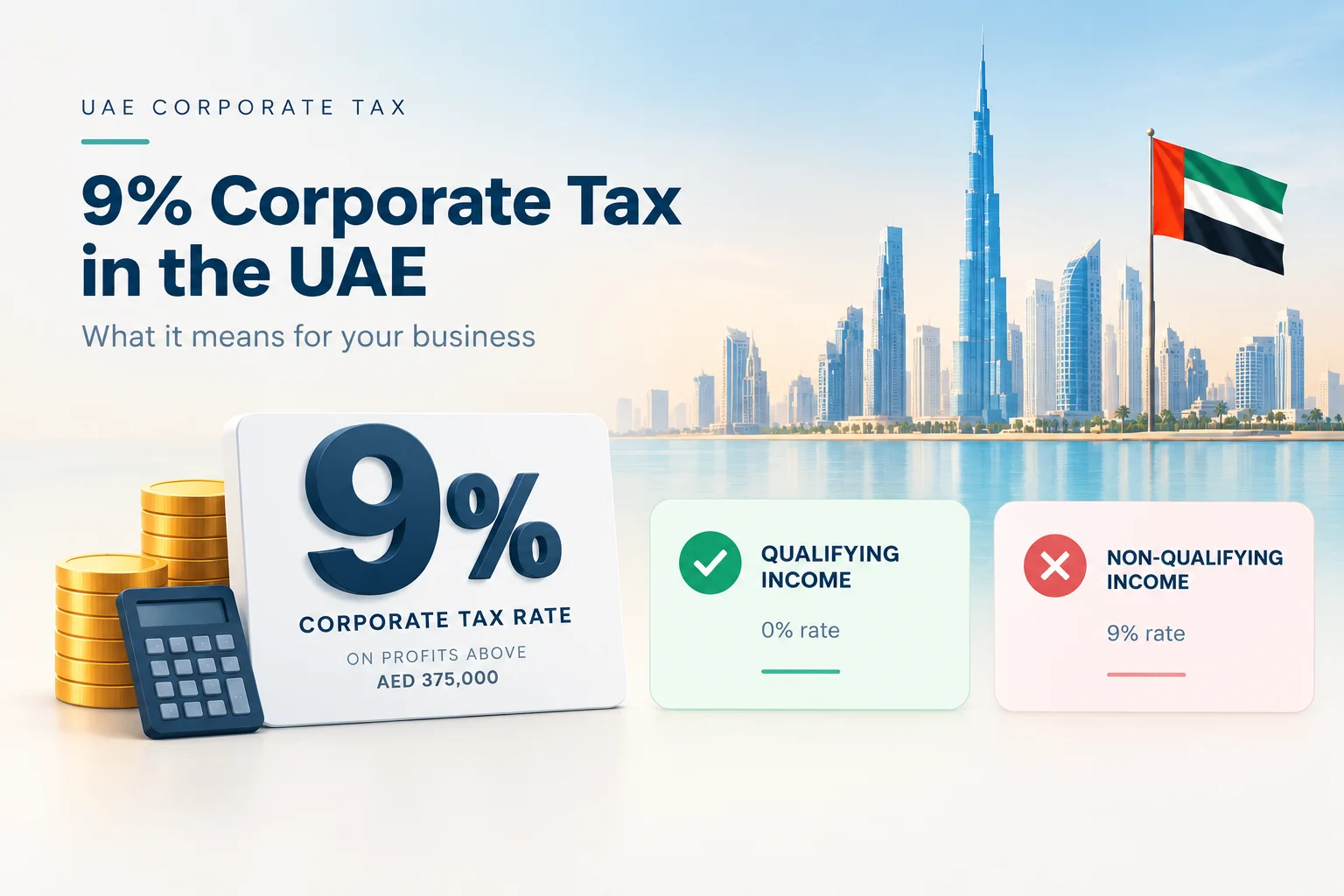
UAE 9% corporate tax rate: qualifying and non-qualifying incomeSince June 2023, the UAE has levied a 9% federal corporate tax on business profits above AED 375,000. Free zone companies can still qualify for a 0% rate, but only on “Qualifying Income,” a defined category that generally covers eligible income from transactions with other free zone entities or from outside the UAE, subject to the applicable conditions.


Income from trading with UAE mainland customers may be treated as non-qualifying and taxed at the standard 9% rate. If a free zone company’s non-qualifying revenue exceeds the applicable de minimis threshold, it can lose its qualifying status for the relevant tax period and potentially subsequent periods. The exact treatment depends on the applicable corporate tax rules.

For an Indian founder exporting services to India, the US, or Europe from a UAE free zone, the treatment depends on whether the income meets the qualifying criteria. It becomes an important tax-planning consideration when the business starts taking on UAE-based customers directly.

Key takeaways:

  • The standard UAE corporate tax rate is 9% on taxable income exceeding AED 375,000.
  • Eligible free zone businesses may qualify for a 0% rate on qualifying income.
  • Not all income earned by a free zone company automatically qualifies for the 0% rate.
  • Transactions with UAE mainland customers require careful assessment under the applicable rules.

For the full corporate tax breakdown, see CSG Advisory’s dedicated guide: UAE Corporate Tax at 9%: Free Zone Exemptions, Qualifying Income, and What Actually Gets Taxed.


Documents and Process for Indian Nationals

For an Indian founder, the typical document set includes the following:

  • Passport copy
  • Emirates ID (once resident)
  • Proof of current address
  • A brief business plan or activity description
  • Passport-size photographs

Visa processing (entry permit, status change if applicable, medical test, Emirates ID application, and visa stamping) generally adds 2–3 weeks to the process, on top of the license issuance itself. Most free zones issue licenses within 3–10 business days when the required documents are submitted correctly the first time.


Real Costs: What It Actually Costs an Indian Founder

License-only pricing in free zone advertising (often AED 5,500–12,500) rarely reflects what a founder actually pays in the first year.

A more realistic first-year cost estimate includes:

  • Business license fees
  • One investor visa
  • Emirates ID
  • Medical fitness test
  • Bank account support
  • Basic registered office or flexi-desk

A more realistic all-in first-year figure typically lands between AED 15,000 and AED 40,000+, depending on the free zone chosen, the number of visas required, and whether office space beyond a flexi-desk is needed.

Costs vary meaningfully between free zones, so get an itemized quote rather than relying on the headline “starting from” figure.


Conclusion

Setting up a UAE company as an Indian founder isn’t complicated mechanically — the paperwork is genuinely straightforward compared to many jurisdictions. The part that catches founders out is everything that happens on the Indian side of the transaction: tax residency rules that don’t change just because you moved, a funding route (ODI, not LRS) that most setup agents never mention, and a DTAA that reduces double taxation rather than eliminating Indian tax exposure altogether.

Before you set up your UAE company, make sure you understand:

  • How your Indian tax residency status will be determined.
  • Whether your company funding must follow the ODI framework.
  • How the India-UAE DTAA may affect your tax obligations.
  • Which UAE and Indian compliance requirements apply to your business.

Getting the UAE side and the Indian side right at the same time is exactly where a dedicated advisory relationship can be valuable compared with relying solely on a company-formation agent. CSG Advisory works with Indian founders on both sides of this process — UAE structuring and the Indian compliance trail behind it — from jurisdiction selection through to ongoing filings.

Ready to plan your UAE company setup? Book a free consultation or message us directly on WhatsApp to discuss your specific situation.

Planning a company or visa move?

Speak to a CSG Advisory specialist. Free 30-minute consultation.

Frequently Asked Questions (FAQs)

Does opening a UAE company make me a non-resident for Indian tax purposes?

No. Your Indian tax residency depends on physical days spent in India and income thresholds under the Income Tax Act, not on where you incorporate a company. You need to track your day count independently of your UAE setup.

Can I use my $250,000 LRS limit to fund my UAE company?

No. Capitalizing a foreign company falls under RBI’s Overseas Direct Investment (ODI) rules, a separate framework from LRS, with its own reporting process through an Authorized Dealer bank.

Will I pay tax in both India and the UAE on the same income?

The India-UAE DTAA is designed to prevent full double taxation through tax credits, but it doesn’t exempt you from Indian tax if you remain an Indian tax resident and the income is attributable to you. Your actual exposure depends on your residency status and how the income is structured.

Is UAE free zone company profit really tax-free?

Only “Qualifying Income” , broadly, income from outside the UAE or from other free zone entities , gets the 0% rate. Income from UAE mainland customers is generally taxed at the standard 9% corporate tax rate.

How much does it realistically cost to set up in year one?

Budget AED 15,000-40,000+ all-in for license, one visa, Emirates ID, and basic compliance , not just the AED 5,500-12,500 headline license fee most ads quote.

Latest Insights

Explore our latest insights and expert advice on international business registration, compliance, and global expansion strategies.