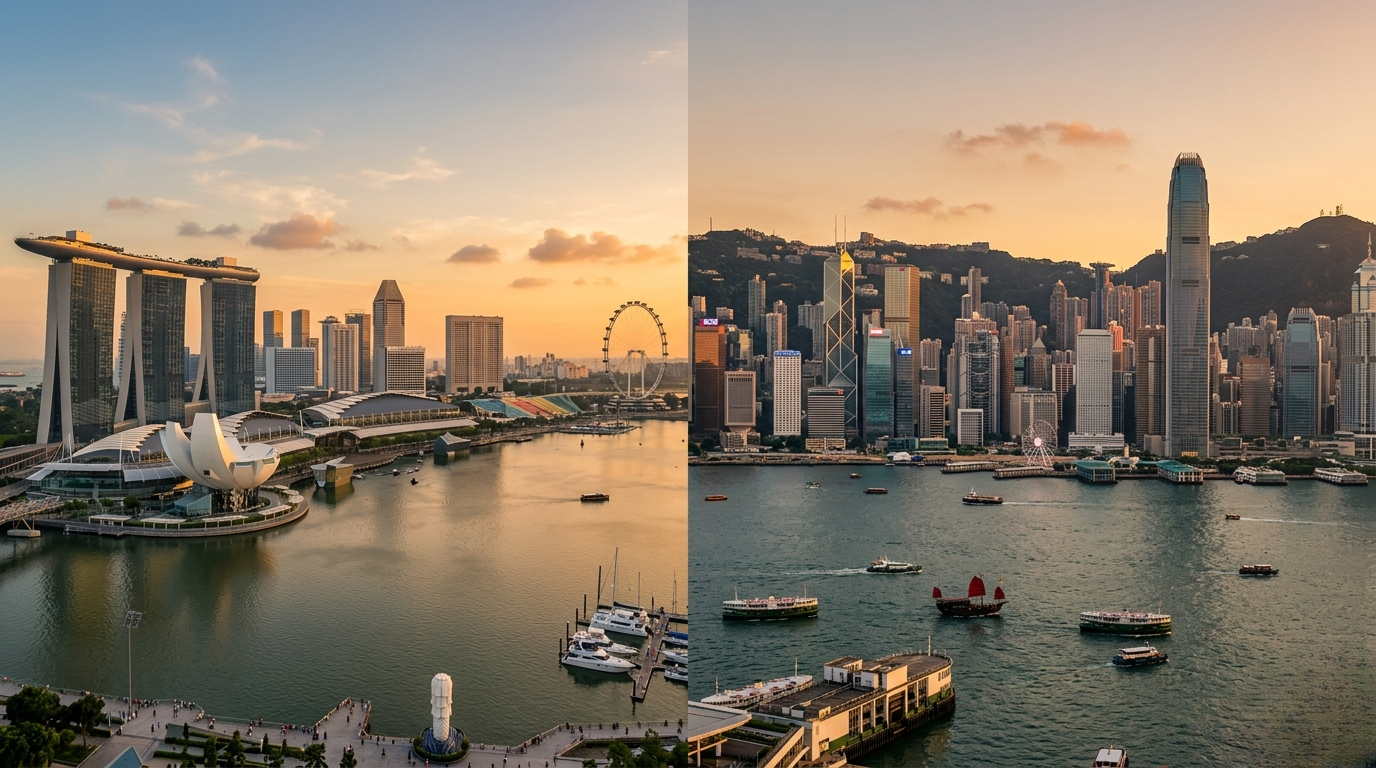
Singapore vs Hong Kong for Company Incorporation: Tax, Banking, and IP Protection Head-to-Head

09 Jun 2026

The Singapore vs Hong Kong company incorporation decision comes up constantly when founders and CFOs are setting up their Asia presence. Both are excellent, low-tax business hubs. Both have stable governments, strong banking, and credible legal systems. But they are genuinely different on corporate tax, banking access, IP structuring, and which markets they connect you to best. Picking the wrong one costs more than people expect.

Key Takeaways

  • Singapore vs Hong Kong company incorporation is a real strategic decision. Both are strong jurisdictions but they suit different business profiles.
  • Singapore’s headline corporate tax rate is 17%, but the effective rate for most businesses is much lower thanks to exemptions and incentives.
  • Hong Kong uses a two-tier rate: 8.25% on the first HKD 2 million of profits and 16.5% above that.
  • The tax comparison Singapore Hong Kong 2026 shows both are territorial systems. Neither taxes foreign income under most circumstances.
  • Singapore or Hong Kong for holding company decisions usually favour Singapore for IP and treaty access, and Hong Kong for China-facing businesses.
  • Banking has become more demanding in both locations.

Singapore vs Hong Kong Side-by-Side Comparison

The clearest way to see how these two jurisdictions differ is a direct comparison. Here is what the Singapore vs Hong Kong company incorporation decision looks like across the factors that matter most.

Criteria Singapore Hong Kong
Corporate tax rate 17% headline; often 5-10% effective with incentives 8.25% up to HKD 2M; 16.5% above
Tax system Territorial; treaty-friendly Territorial; simpler structure
Tax treaties Over 90 Over 45
IP regime IP Development Incentive (5-10% on qualifying IP income) No IP box regime
Minimum directors 1 (resident director required) 1 (no residency requirement)
Minimum shareholders 1 1
Company secretary Required; must be resident Required; must be resident
Audit requirement Yes unless exempt as small company Yes for all companies
Setup time 1 to 3 business days 5 to 10 business days
Setup cost (estimate) USD 1,500 to 3,000 USD 1,200 to 2,500
Annual compliance cost USD 2,500 to 5,000 USD 2,000 to 4,000
Banking access Demanding but workable; digital alternatives growing Demanding; China-link scrutiny high
Best fit Southeast Asia, India, Middle East, IP holding China-facing business, capital markets

Why This Decision Matters More in 2026

The Singapore or Hong Kong for holding company question has sharpened recently. Both jurisdictions are responding to global minimum tax rules and increased scrutiny of offshore structures. A business that incorporated in Hong Kong a decade ago primarily for China market access may now find Singapore makes more sense as revenue diversifies into Southeast Asia, India, or the Middle East.

At the same time, Hong Kong’s deep connection to mainland China through its tax treaty and regulatory framework is genuinely hard to replicate from Singapore. If China is central to your business, that advantage still matters.

Neither jurisdiction is automatically better. The answer comes from looking at your specific business, your customers, and your plans.

Tax Comparison Singapore Hong Kong 2026: What the Numbers Actually Mean

Singapore Corporate Tax

Singapore’s headline rate is 17%. In practice, most businesses pay considerably less. New companies benefit from the Start-up Tax Exemption: 0% on the first SGD 100,000 of chargeable income and 8.5% on the next SGD 100,000 in their first three years. Beyond that, sector-specific incentives administered by Singapore’s Economic Development Board can bring effective rates for businesses in priority sectors into single digits.

Singapore is a territorial tax system. Foreign income received in Singapore is generally exempt if it has already been taxed in the source country at a rate of at least 15%.

Hong Kong Corporate Tax

Hong Kong has a two-tier profits tax. The first HKD 2 million of assessable profits is taxed at 8.25%. Everything above that is taxed at 16.5%. Only one company per corporate group can use the lower rate.

Like Singapore, Hong Kong is territorial. Profits genuinely arising outside Hong Kong are not taxed. For businesses where income is clearly sourced offshore, this is a strong position. Hong Kong’s offshore profits claim, however, requires demonstrating that the relevant profits actually arose outside Hong Kong through specific evidence of where decisions and activities took place.

The Real Comparison

For a small business with profits under HKD 2 million, Hong Kong’s 8.25% is lower than Singapore’s 17% headline. But Singapore’s incentive ecosystem means that growing companies in the right sectors often achieve effective rates well below 17%. For IP-intensive businesses, Singapore’s innovation incentives can bring the rate down to 5% to 10% on qualifying IP income.

The tax comparison Singapore Hong Kong 2026 is not a simple win for either side. It depends on your profit size, your sector, and what incentives you can access.

Singapore-vs-Hong-Kong

What About Audit Requirements and Annual Compliance Costs?

Singapore requires all companies to prepare annual financial statements. Companies that qualify as small companies under the Singapore Companies Act may be exempt from statutory audit. To qualify, a company must meet at least two of three criteria: annual revenue below SGD 10 million, total assets below SGD 10 million, and fewer than 50 employees. Companies that do not meet these thresholds must have their accounts audited.

Hong Kong requires all companies to have their accounts audited annually, regardless of size. This is a meaningful compliance cost for small businesses. Audit fees in Hong Kong typically start from around HKD 8,000 to 15,000 for basic accounts and increase with company complexity.

Annual compliance costs in Singapore typically run USD 2,500 to 5,000 for a straightforward company with professional company secretary, accounting, and annual return filing. Hong Kong sits at a similar level, around USD 2,000 to 4,000, though the mandatory audit adds cost for smaller businesses that might be exempt in Singapore.

Singapore or Hong Kong for Holding Company: Which One Wins?

Treaty Network

Singapore has over 90 double tax treaties. This reduces the withholding taxes on dividends, royalties, and interest flowing through a Singapore holding structure. For businesses with subsidiaries in Southeast Asia, India, or the Middle East, this treaty breadth is a real advantage.

Hong Kong has more than 45 tax treaties. Its treaty with mainland China is particularly valuable. For businesses structured around China operations, the Hong Kong-China treaty offers benefits that Singapore cannot replicate.

IP Holding and Innovation Incentives

Singapore’s IP Development Incentive and related programmes allow qualifying IP income to be taxed at rates as low as 5% to 10%. For businesses that own and license intellectual property across Asia, Singapore is the stronger location.

Hong Kong does not currently have a comparable IP box regime. If IP income is a significant part of your business, Singapore has the clear structural advantage.

Substance Requirements

Both jurisdictions have moved toward requiring genuine operational substance. Singapore requires companies claiming incentives to have real economic activity, employees, and decision-making in Singapore. Hong Kong companies claiming offshore profits exemption must demonstrate that the profits genuinely arose outside Hong Kong through real business activity.

Neither jurisdiction accepts shell companies with no real presence as the basis for tax benefits. Setting up in either location purely for tax purposes without genuine operations is increasingly difficult to sustain.

How Does Each Compare to BVI or Cayman for Pure Holding Structures?

Singapore and Hong Kong are operating jurisdictions. They are appropriate for companies with genuine business activity, real banking relationships, and substance. They are not pure offshore vehicles in the way BVI and Cayman are.

BVI and Cayman structures offer lower setup and maintenance costs for pure holding purposes and greater privacy in some contexts. But they come with limitations on banking access, treaty benefits, and credibility with institutional counterparties. Singapore and Hong Kong sit above BVI and Cayman in terms of substance, banking access, and regulatory standing.

Many structures use both: a Singapore or Hong Kong operating entity with a BVI or Cayman holding layer above it. The right combination depends on the specific investor base, banking needs, and ownership structure.

Banking: Is Singapore or Hong Kong Easier to Open?

The honest answer is that both have become significantly more demanding over the past few years.

Singapore Banking

Singapore’s major banks, DBS, OCBC, and UOB, require a physical presence interview for new account openings. They want full KYC documentation, a clear and credible business model, and a genuine Singapore nexus. For businesses with complex multi-jurisdiction ownership or passive income structures, account approval has become selective. Digital banks and licensed payment institutions are increasingly used as alternatives for certain business models.

Hong Kong Banking

Hong Kong’s banking environment tightened significantly from around 2017 onwards. HSBC, Standard Chartered, and Hang Seng all run rigorous compliance processes. Companies with mainland Chinese beneficial owners and limited local operational substance face particular difficulty. For businesses incorporated in Hong Kong primarily for China access but with no genuine Hong Kong presence, banking has become one of the most common practical problems.

Practical Advice

Do not choose your incorporation jurisdiction primarily based on banking ease. Get the structure right first and engage a professional banking introducer for the account. Our team at CSG Advisory helps with both: www.csgadvisory.com/services/corporate-banking/

How to Make the Decision: Four Factors That Actually Matter

  • Revenue geography: If most of your clients and income are in Southeast Asia, India, or the Middle East, Singapore is the stronger base. If China-facing revenue dominates, Hong Kong is more relevant.
  • IP ownership: If your company will own and license intellectual property, Singapore’s incentive regime makes it the clearer choice.
  • Treaty access: For complex holding structures across multiple countries, Singapore’s treaty network is broader in most situations outside China.
  • China connection: If you need smooth integration with mainland China operations, Hong Kong’s China tax treaty and regulatory alignment provide advantages Singapore cannot match.

Many businesses with genuinely global operations use both: a Singapore entity for Southeast Asia and IP, and a Hong Kong entity for China activity, with proper transfer pricing governance between them.

Choosing the Right Structure From Day One

The Singapore vs Hong Kong company incorporation decision is easier when it is driven by your business model rather than assumptions about which sounds better. Both jurisdictions reward businesses with genuine operations, clear revenue streams, and proper governance.

If you are deciding between the two, or want to explore whether a dual jurisdiction structure makes sense, we can help you map the options against your specific situation.

Reach out at www.csgadvisory.com/services/company-registration/ to speak with our team.

Singapore-vs-Hong-Kong

Frequently Asked Questions (FAQs)

Is it better to incorporate in Singapore or Hong Kong in 2026?

The Singapore vs Hong Kong company incorporation decision depends on your business. Singapore is generally the stronger choice for IP holding, treaty access, and serving Southeast Asia, India, and the Middle East. Hong Kong remains better for businesses with strong China connections and those accessing Hong Kong capital markets. For businesses without a clear China focus, Singapore’s broader treaty network and IP incentives make it the more versatile option in 2026.

Which has lower corporate tax in Singapore or Hong Kong?

The tax comparison Singapore Hong Kong 2026 shows Hong Kong has a lower headline rate on smaller profits: 8.25% up to HKD 2 million versus Singapore’s 17%. However, Singapore’s Start-up Tax Exemption and sector incentives mean growing businesses often pay comparable or lower effective rates. For IP income, Singapore’s innovation incentives can bring the effective rate down to 5% to 10%.

Is Singapore or Hong Kong easier for opening a corporate bank account?

Both jurisdictions have become more compliance-intensive for corporate banking. Singapore has stronger digital banking alternatives and generally clearer compliance expectations. Hong Kong banks are particularly cautious about China-related beneficial ownership and companies with limited local substance. In both cases, working with a professional banking introducer significantly improves your chances of a clean account opening.

What are the annual compliance costs in Singapore vs Hong Kong?

Annual compliance costs in Singapore typically run USD 2,500 to 5,000 for company secretarial services, accounting, and annual return filing. Hong Kong is similar at USD 2,000 to 4,000, but the mandatory audit for all Hong Kong companies adds to the cost for smaller businesses that would be audit-exempt in Singapore.

How does Singapore vs Hong Kong compare to Dubai for company incorporation?

All three are strong jurisdictions with distinct advantages. Dubai and UAE free zones offer 0% to 9% corporate tax, no capital gains tax, and straightforward company formation. Singapore suits Asia-Pacific businesses with IP and treaty access needs. Hong Kong suits China-facing businesses. Dubai is often the right choice for Middle East market access and international founders who want a UAE presence. Many global businesses use two or three of these jurisdictions for different purposes within the same group structure.

Latest Insights

Explore our latest insights and expert advice on international business registration, compliance, and global expansion strategies.